
A potential customer fills out a form after seeing an Instagram ad. Someone else asks for pricing through the website. Another prospect comes through a referral, while a fourth responds to a Google campaign.
The business has generated leads. The difficult part begins next.
One inquiry receives a quick response. Another sits unnoticed for three hours. A salesperson calls someone who is busy and forgets to follow up later. A promising prospect receives one message and then disappears from the sales team's radar.
For many businesses, the problem is not always generating interest. It is converting that interest into an actual conversation.
This is where WhatsApp marketing software in India is increasingly becoming part of the sales process. Instead of treating WhatsApp as another place to send promotional messages, businesses can use it to structure communication from the first inquiry through follow-up, qualification and repeat engagement.
The Real Lead Problem Is Often What Happens After Someone Shows Interest
Businesses spend considerable time and money attracting prospects through Google Ads, social media, SEO, marketplaces, exhibitions, referrals and offline promotions.
But lead generation is only the beginning.
Imagine a coaching institute generating 80 inquiries after announcing a new course. The sales team may respond quickly to the first 20 or 30. As more inquiries arrive, however, communication starts becoming inconsistent.
Some prospects receive information immediately.
Some wait.
Others may receive a call but no follow-up message.
A few might simply be forgotten.
The same problem can occur in real estate, retail, healthcare, B2B sales and almost any business handling multiple inquiries.
When communication is scattered between personal phones, spreadsheets, calls and individual chats, opportunities can easily fall through the cracks.
Speed matters, but consistency matters just as much.
A prospect who was interested on Monday may have spoken to three competing businesses by Wednesday.
Where WhatsApp Fits Into the Modern Customer Journey
WhatsApp already sits naturally inside everyday communication for many Indian consumers and businesses.
The opportunity is therefore not simply to "send WhatsApp messages". It is to understand where conversations can support the customer's decision.
A typical journey might look something like this.
Discovery
Someone discovers a business through search, advertising, social media, an event, a referral or another marketing channel.
Initial inquiry
The prospect asks for a quotation, brochure, appointment, product information or additional details.
Follow-up
Not everyone makes a decision immediately. Some prospects need reminders, comparisons, additional information or simply more time.
Updates
Businesses may need to share appointment confirmations, product information, availability, documents, event details or other relevant updates.
Repeat engagement
Previous customers and warm prospects can also be contacted about genuinely relevant developments, services or offers where appropriate.
WhatsApp can therefore work across several stages rather than being restricted to promotional broadcasting.
How WhatsApp Marketing Software in India Can Support Lead Generation
As inquiry volumes increase, manually managing every conversation becomes difficult.
The role of marketing software is primarily to bring greater structure to communication.
Businesses can organize contact lists, segment relevant audiences, schedule campaigns, personalize messages and maintain more consistent follow-up processes.
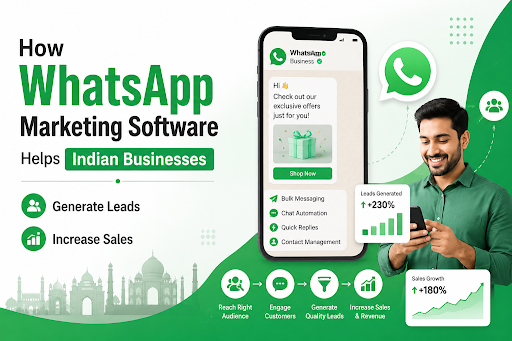
Such WhatsApp marketing solutions include campaign management, contact segmentation, scheduled messaging, automated workflows and centralized reporting. Depending on the platform, additional capabilities may include lead imports and live chat, allowing businesses to manage different parts of the communication journey from one system.
The advantage is not merely sending more messages.
It is reducing the amount of manual coordination required to keep conversations moving.
Consider a real estate company receiving inquiries for several projects. Rather than sending every prospect identical information, contacts can be grouped according to factors such as project interest, location or stage of inquiry.
Relevant communication can then be sent to the appropriate segment.
That is substantially different from indiscriminate bulk messaging.
From First Message to Sales Conversation
A healthy WhatsApp lead journey can be viewed as a simple funnel:
Each stage has a different purpose.
Prospect:
A relevant person enters the business's lead pipeline.
Message:
The business starts or continues a useful conversation.
Response:
The prospect shows interest by replying, asking a question or taking another action.
Qualification:
The business determines whether the person genuinely fits its product or service.
Follow-up:
Relevant information is provided until the prospect is ready to make a decision.
Sales opportunity:
A salesperson takes the conversation forward towards a quotation, consultation, demonstration, appointment or purchase.
The critical point is that WhatsApp does not create the sale by itself.
It helps keep the conversation moving.
Business Situations Where WhatsApp Marketing Becomes Useful
The value of structured WhatsApp communication changes depending on the buying journey.
Real estate
Property inquiries often require multiple follow-ups. Teams may use WhatsApp to send project information, coordinate site visits and reconnect with prospects who have not yet decided.
Education
Institutes can communicate course information, counseling schedules, admission updates and reminders to relevant prospective students.
Retail
Retail businesses may use WhatsApp for product updates, customer inquiries, order-related communication and relevant promotional campaigns.
Local services
Clinics, repair businesses, consultants and other service providers can use structured communication for inquiries, appointments and follow-ups.
B2B companies
B2B sales cycles are often longer. WhatsApp can complement email and calling by providing another channel for relevant follow-up conversations.
Marketing agencies
Agencies handling large contact databases or campaigns may require better segmentation, scheduling and campaign organization than manual messaging allows.
Business messaging software can also support sectors including retail, education, real estate, marketing agencies, healthcare and direct sales teams.
More Messages Do Not Automatically Mean More Sales
This is where many WhatsApp strategies go wrong.
A company acquires software capable of reaching a larger audience and assumes that increasing message volume will automatically increase revenue.
It will not.
Poor targeting at scale simply creates more poor communication.
Four factors matter considerably more.
Relevance
Someone interested in one service should not repeatedly receive messages about unrelated products.
Timing
Follow up while the inquiry is still active rather than weeks after the prospect has already chosen a competitor.
Permission and responsible outreach
Businesses should follow applicable platform requirements, privacy expectations and communication regulations rather than treating every available phone number as permission to send promotional messages.
Message quality
Generic messages such as "BEST OFFER!!! CALL NOW!!!" provide very little reason for someone to respond.
Useful communication should answer the question the prospect is already thinking about.
For example:
Instead of simply promoting a property, tell the prospect that the floor plan they requested is available.
Instead of repeatedly advertising a course, provide the upcoming counseling date they asked about.
Context produces conversations. Volume alone does not.
A Better Way to Build Your WhatsApp Lead Strategy
Before increasing campaign volume, businesses should build a simple communication framework.
Start by identifying where leads originate and what information each source normally requires. Separate new inquiries from existing customers and old prospects. Create meaningful contact segments rather than one enormous database. Decide which conversations genuinely benefit from automation and which require a salesperson. Prepare useful follow-ups for prospects who do not respond immediately. Monitor campaign responses and refine messages based on what people actually engage with.
Most importantly, give every message a clear purpose.
The goal should not be:
"How many messages did we send?"
A better question is:
"How many relevant conversations did we create?"
That change in thinking makes WhatsApp far more useful as a sales channel.
Turn Conversations Into a Repeatable Sales Channel
Businesses usually do not lose leads because they lack communication channels.
They lose them because communication becomes inconsistent as inquiry volumes increase.
The right WhatsApp marketing software in India can help turn scattered conversations into a more organized lead-management process, making it easier to segment contacts, run relevant campaigns and maintain structured follow-ups.
At The Future Tech, we provide WhatsApp marketing and business messaging solutions designed for Indian businesses that want to manage customer communication, campaigns and automation more systematically. Our solutions include options for campaign management, automated workflows, segmentation and business messaging at scale.
Technology, however, is only one part of the equation.
The strongest results come when the software supports a sensible sales process: reach the right prospect, communicate something relevant, respond quickly and continue the conversation until there is a genuine opportunity to sell.
Frequently Asked Questions
1. What is WhatsApp marketing software?
WhatsApp marketing software helps businesses organize and manage customer communication through WhatsApp. Depending on the solution, functionality may include contact segmentation, campaign management, scheduling, personalization, automation, reporting and team-based communication.
2. Can WhatsApp marketing help generate leads?
WhatsApp can support lead generation by helping businesses communicate with prospects, respond to inquiries and follow up with interested contacts. However, the quality of the audience, offer, targeting and message remains more important than message volume.
3. Is WhatsApp useful only for B2C businesses?
No. B2B companies can also use WhatsApp for inquiry follow-ups, consultation scheduling, quotation discussions, product information and ongoing prospect communication, particularly when customers are comfortable using the channel.
4. Which industries can benefit from WhatsApp marketing?
Real estate, education, retail, healthcare, local services, marketing agencies, professional services and B2B companies are among the sectors that can use WhatsApp as part of their customer communication process.
5. Can WhatsApp marketing replace calling and email?
Usually, no. WhatsApp works best as part of a broader communication strategy. Some conversations may be easier through WhatsApp, while detailed proposals may still belong in email and important sales discussions may require a phone or video call.
6. What should businesses look for in WhatsApp marketing software?
Businesses should consider features such as contact management, segmentation, campaign scheduling, automation, personalization, reporting, ease of use and the ability to fit the software into their existing lead-management process.