
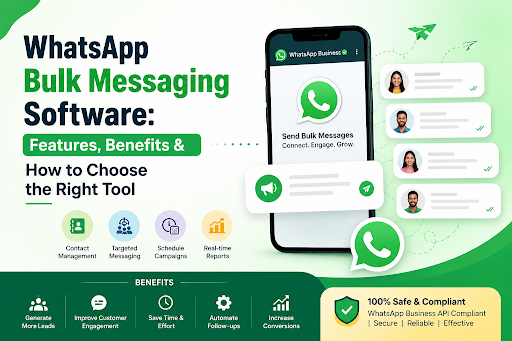
Sending a message to hundreds or thousands of contacts is the easy part. The harder part is keeping those conversations relevant, organized and manageable as the audience grows.
This is where WhatsApp Bulk Messaging Software can be beneficial. Communication with other businesses isn't about a long list of numbers and one message repeated and repeated again, the correct software can help teams organize contacts, segment audiences, manage campaigns, personalize communication and understand how the messaging activity is performing.
So, what's not to love about a tool that can send messages in bulk, right? It's the extent to which it can enable your team to communicate with customers and prospects in a way that's consistent with how they prefer to communicate.
What Does WhatsApp Bulk Messaging Software Actually Help With?
Bulk messaging software is designed to make high-volume business communication easier to control.
Rather than manually contacting people one at a time, businesses can use a centralized system to organize contacts, prepare campaigns, schedule communication and monitor messaging activity. Depending on the platform, teams may also be able to create automated workflows, group contacts using tags and review campaign reports.
Such messaging platforms may offer campaign management, contact segmentation, scheduling, reporting and automated workflows as part of their business communication offering.
For businesses with an expanding contact base, these functions can make the difference between organized communication and an increasingly difficult manual process.
Features That Matter in Everyday Business Use
A long feature list can look impressive without telling you whether a platform will actually make work easier. A better way to evaluate software is to connect each capability to the problem it solves.
Contact organization keeps growing databases manageable
Once a company starts receiving inquiries from multiple campaigns, locations or sales channels, one undifferentiated contact list quickly becomes difficult to work with.
Contact-management features help teams keep information organized so that salespeople and marketers can work with more relevant groups instead of repeatedly sorting spreadsheets.
Audience segmentation improves message relevance
Not every contact should receive the same message.
A property buyer who inquired about a specific project has different expectations from someone who simply downloaded a brochure months ago. Similarly, a current customer may need service updates while a new prospect may need introductory information.
Tagging, grouping and segmentation allow businesses to communicate according to context rather than sending the same campaign indiscriminately. Some platforms support tag and group targeting as well as contact segmentation.
Campaign management brings structure to outreach
Without campaign management, teams can lose track of what was sent, when it was sent and who received it.
A campaign interface provides a clearer way to prepare, schedule and manage communication from one place. This is particularly useful when several campaigns are being handled simultaneously.
Personalization makes communication less generic
The convenience of bulk communication should not automatically produce impersonal messaging.
Tools that support personalized message templates can help businesses incorporate relevant customer details into campaigns instead of sending communication that reads like an anonymous broadcast. Some business messaging tools support personalized templates and contact imports through Excel, CSV and text files.
Reporting helps teams understand activity
Sending is only the beginning.
Reporting and campaign history can help teams understand what has been delivered, when campaigns were run and how recipients interacted with different communication flows. Some platforms include live sending history, scheduled logs and flow or form performance reporting.
What Businesses Can Gain From a More Structured Messaging Process
The biggest benefit of WhatsApp Bulk Messaging Software is not simply speed. It is the ability to turn a repetitive communication task into a more structured business process.
Faster communication matters when teams are managing a large number of inquiries. Instead of repeatedly preparing individual messages, campaigns can be planned and executed more efficiently.
Follow-up can also become more consistent. Prospects are less likely to disappear into forgotten spreadsheets when contacts, campaigns and communication workflows are managed through an organized system.
Teams can also gain better visibility. When campaign histories, schedules and contact groups are accessible from one place, it becomes easier to understand what has already happened and what needs attention next.
Most importantly, structured messaging makes relevance easier to maintain as the database grows.
Bulk Messaging vs Random Mass Messaging
This distinction matters.
Bulk does not mean indiscriminate.
A responsible bulk messaging strategy starts with the audience, not the send button.
Recipients should have a reasonable expectation of hearing from the business. Messages should relate to their interests, inquiry history, customer relationship or another relevant context. Audience groups should be defined carefully rather than treating every available phone number as an identical prospect.
Consider two approaches.
A real estate company sends the same property advertisement to every number in its database.
Another company separates people according to location, property preference and previous inquiry before communicating relevant listings.
Both companies may technically be sending messages in bulk, but only one is using structured targeting.
The same principle applies to frequency. More messages do not automatically produce better engagement. Excessive or irrelevant communication can damage trust and make recipients less receptive to future messages.
Businesses should therefore combine appropriate targeting, recipient expectations and sensible campaign frequency with the platform's applicable messaging rules.
Which Businesses May Find It Useful?
A real estate team might receive inquiries from several projects every week. Instead of manually checking old spreadsheets, the team could organize prospects according to the project or location they showed interest in and manage subsequent follow-up more systematically.
An education business may need to communicate course information, reminders or relevant updates to prospective students who have already expressed an interest. Segmentation can help separate audiences according to programs, locations or inquiry stages.
A service company might use structured campaigns for appointment communication, customer updates, service reminders or relevant promotions while keeping different customer groups organized.
A B2B sales team could use messaging alongside its broader prospecting process to maintain communication with qualified contacts without relying entirely on individual manual follow-ups.
The common factor is not industry. It is communication volume.
Once a business is dealing with enough contacts that manual messaging becomes inconsistent or difficult to manage, software starts to become more valuable.
Five Questions to Ask Before Selecting Your Software
1. What is our primary use case?
Start with the actual problem.
Do you need to manage incoming leads? Run promotional campaigns? Follow up with prospects? Send customer updates? Automate repetitive communication?
Software should be selected around the workflow, not around the longest feature list.
2. Who will operate it?
A platform used every day by a small sales team needs to be easy enough for those users to understand.
A technically capable tool that nobody feels comfortable operating creates another bottleneck rather than solving one.
3. How will contacts be organized?
If you have several customer types, locations, products or stages in the sales journey, contact organization becomes particularly important.
Look at how the software handles importing, grouping, tagging and segmentation.
4. What campaign capabilities do we genuinely need?
Scheduling, workflows, personalization, media attachments and reporting can all be useful, but not every company needs every function.
Identify what affects your daily workflow before adding complexity you may never use.
5. How will we measure whether communication is working?
Do not define success as "messages sent."
Depending on your objective, useful indicators could include replies, inquiries, appointments, qualified leads, repeat interactions or conversions.
Choose software that gives your team enough visibility to judge whether campaigns are supporting those objectives.
The Tool Is Only Half of the Equation
No messaging platform can rescue a weak communication strategy.
Good results depend on several elements working together:
- The right audience
- Useful and relevant messaging
- Appropriate timing
- Sensible campaign frequency
- Clear next steps
- An organized follow-up process
Software supports these decisions; it does not replace them.
A highly capable platform sending irrelevant messages to poorly selected contacts will still perform badly. Meanwhile, a team that understands its audience but lacks an organized system may struggle to maintain that quality once communication volume increases.
The strongest setup combines both.
Build a Messaging System Your Team Can Actually Use
At The Future Tech, we offer business messaging solutions designed around campaign management, segmentation, scheduling, automated workflows, contact importing, personalization and reporting. Businesses can use these capabilities to bring more structure to outreach instead of relying entirely on manual messaging processes.
When evaluating WhatsApp Bulk Messaging Software, however, the deciding factor should remain practical: does the platform fit your audience, your workflow and the way your team intends to communicate?
The best software is not necessarily the one with the most features. It is the one your team can use consistently to deliver relevant communication without turning campaign management into another complicated task.
Frequently Asked Questions
1. What is WhatsApp bulk messaging software used for?
It is used to manage high-volume business communication more systematically. Depending on the software, businesses may be able to import contacts, organize audiences, personalize messages, schedule campaigns, create workflows and review messaging activity.
2. Is bulk messaging the same as sending the same message to everyone?
No. Effective bulk communication can involve segmentation and targeting so that different groups receive messages relevant to their interests, relationship or stage in the customer journey.
3. Can contacts be imported from spreadsheets?
Some platforms support spreadsheet-based imports. Compatible tools may allow contacts to be imported through Excel, CSV or text files.
4. Can businesses personalize bulk campaigns?
Yes, where the chosen platform provides personalization features. Personalized templates can help businesses adapt messages using available contact information rather than relying entirely on generic broadcasts.
5. What reporting features should businesses look for?
Useful reporting depends on the objective, but campaign history, sending status, scheduled activity and engagement with communication flows can provide valuable visibility into campaign performance.
6. What should I consider before choosing a bulk messaging platform?
Consider your main use case, expected contact volume, user experience, audience-segmentation requirements, campaign-management needs, reporting capabilities and how easily the software fits into your existing sales or marketing process.