
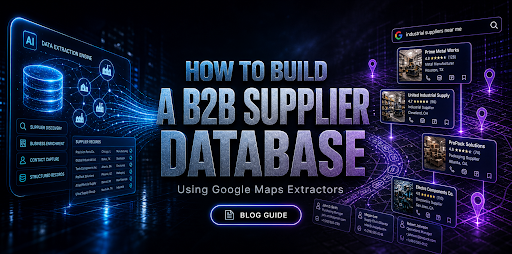
Today, when the business environment is highly competitive, access to a proper supplier database may provide a considerable advantage to any enterprise. If you need to get some raw material, form partnership relations, or enlarge your supplier’s base, reliable data will be crucial. There is one really efficient way to get such data; it is the use of Google Maps extract, which helps businesses gather supplier information fast.
Why Google Maps is a Valuable Data Source
Firstly, it should be mentioned that Google Maps is not only a navigator but also the largest directory containing various kinds of companies. It contains information about manufacturers, wholesalers, and service organizations of any size. As a rule, each page features the following elements:
- Business name
- Address and location
- Contacts
- Links to the website
- Customer reviews and rates
Thus, it makes for a great source upon which to construct a well-formatted B2B vendor database.
Understanding the Basics of Data Extraction
But first things first, it is vital that we define the concept of data extraction in order to better understand what follows in the article. Essentially, it entails obtaining publicly available information from Internet-based sources and presenting it in a useful form, such as a spreadsheet or CRM software.
Google Maps extractors streamline the whole operation, eliminating the need for time-consuming manual searches for particular items. These programs make it possible to extract data in batches according to predefined parameters.
Step-by-Step Approach to Building Your Database
1. Define Your Target Supplier Criteria
Firstly, define exactly which types of suppliers you are looking for. This will help to refine your search and reduce unnecessary data collection.
Ask yourself:
- What industry or market segment do I want to target?
- What geographic areas are important to me?
- What sizes or types of businesses should I focus on?
Setting clear criteria helps to keep your database relevant and focused.
2. Use Relevant Search Queries
During your search on Google Maps, utilize highly targeted search terms. Examples include:
- "Suppliers of industrial machinery in Mumbai"
- "Textile production factories near Surat"
- "Electronics wholesalers in Delhi"
These targeted searches help to gather more relevant listings.
3. Extract Data Efficiently
Having specified your search parameters, you may move forward with the information extraction from the Google Maps extract tool. There are specific tools designed for the process of extracting hundreds or even thousands of business listings within a matter of minutes.
Typically, the extracted data includes:
- Company names
- Phone numbers
- Emails (where possible)
- Website URLs
- Customer ratings
This is an important stage as it helps to convert unstructured web information into structured business intelligence.
Organizing and Cleaning Your Data
Raw data can be inconsistent, have duplicates, and have missing fields. Cleaning and arranging your data is vital in making it useful.
Here is how you can achieve that:
- Eliminate duplicated data
- Standardize format (i.e., phone numbers, addresses)
- Input any missing information
- Classify the supplier according to industry and relevance
Organized data makes your database user-friendly and more efficient in decision-making.
Enhancing the Database for Better Results
Having the data alone isn't sufficient; you need to take additional steps to refine the data for it to be helpful.
Add Value Through Segmentation
Segment your database using:
- Location-based groups
- Industry categories
- Business size or ratings
This way, you can reach out to specific targets and increase response rates.
Verify Supplier Authenticity
Some of the listings on Google Maps aren't updated or accurate. Therefore, it's advisable to confirm the authenticity of critical suppliers by visiting:
- Visiting their website
- Checking reviews
- Making a quick call
The action ensures reliability and avoids business risks.
Integrate with CRM Tools
For maximum benefit, connect your database with your CRM and sales tools. It will enable you to:
- Communicate efficiently
- Lead management
- Automation of follow-up tasks
Having a connected system increases productivity and makes supplier management easier.
Common Challenges and How to Overcome Them
The process of building a database with Google Maps is efficient; however, it does come with some challenges:
- Incomplete data: Not all listings have full contact details
- Duplicate entries: Multiple listings for the same business
- Data accuracy: Outdated or incorrect information
To solve this issue:
- Use reliable data extraction software
- Verify crucial data
- Maintain your database regularly
Consistency is essential in maintaining your database and making sure that it stays up-to-date.
Ethical Considerations in Data Collection
In data extraction, one should ensure that only publicly available data is used. One should not spam the business but rather use ethical methods to reach out.
By respecting the privacy of other people and being transparent in your communications, you can build trust and credibility in the long run.
Making Your Database Work for You
When you're done building your database, what comes next? Here are some ways you can benefit from having such a resource:
- Supplier outreach and partnerships
- Market research and competitor analysis
- Expanding into new regions
- Improving procurement strategies
A well-built database is not just a list; it’s a strategic asset for business growth.
Turning Data into Growth Opportunities
A manually built supplier database can be a cumbersome task, but automation is very helpful in speeding up the process. With the Google Maps extract, it will be easy to achieve the goal and save some time, as well as reach a larger number of suppliers.
In the modern world, being equipped with the right tools and strategy helps a lot. If you are interested in getting better ways of extracting, organizing, and analyzing business data, it may be good to turn to The Future Tech. Their specialists can provide a variety of services aimed at facilitating the process of using business data. This can include data scraping techniques and other useful methods.